
Swiggy verification codes should not be read to an unsolicited caller claiming to arrange a refund. The official customer-care page warns against giving OTPs to strangers and directs order issues to in-app help. A phone number appearing in search results is not proof of an official support route.
Open help from your own order
Locate the relevant order inside the official app and inspect its actual state. If an issue exists, describe it through that order or the app's help section. Do not enter account or payment information through a link supplied by the caller. Knowing a restaurant name is not sufficient source verification.
If you initiated no task, a newly received value should not be treated as a refund receipt. Read its purpose and compare it with the official page. The caller's label does not determine what the value authorizes or whether a matching operation exists.
| Claim or observation | Where to check |
|---|---|
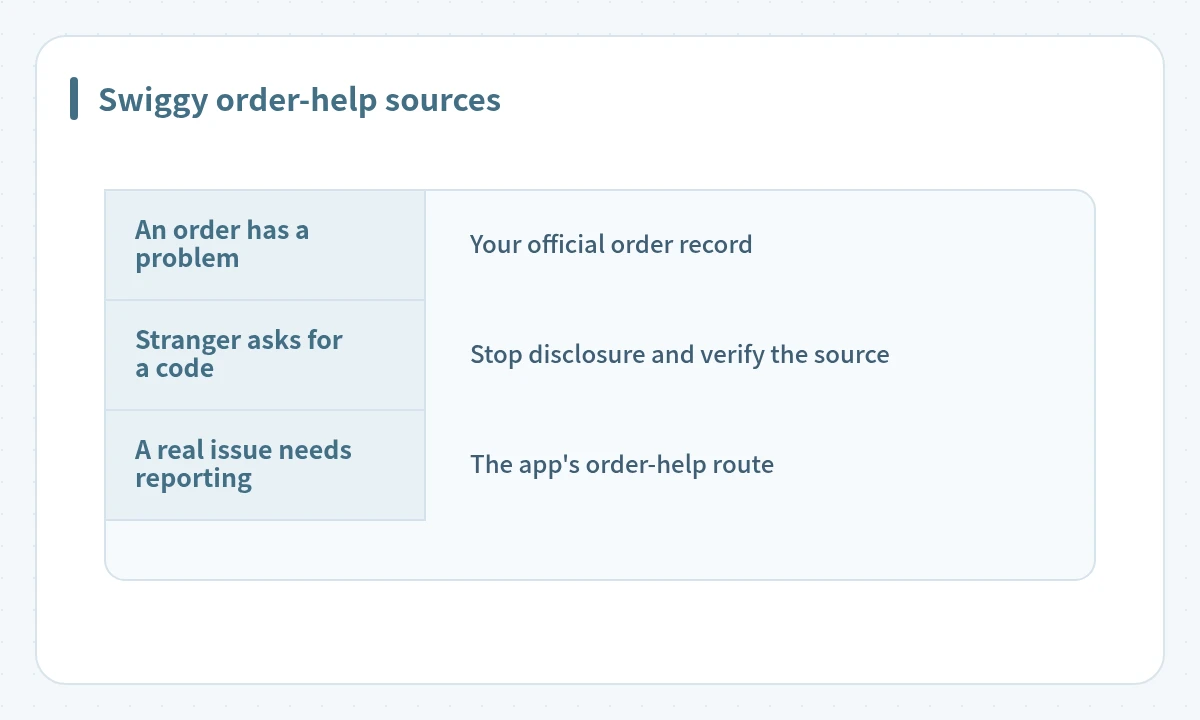
| An order has a problem | Your official order record |
| Stranger asks for a code | Stop disclosure and verify the source |
| A real issue needs reporting | The app's order-help route |
Do not use a private value to prove order ownership
Access credentials belong to their corresponding official task. A caller saying identity confirmation does not justify reading them aloud. A screenshot containing a value, link, or full personal information should not be sent to a social account offering to handle the case.
Swiggy's fraud warning identifies fake helplines, suspicious sites, and refund claims. Start from the official app you opened yourself rather than testing a series of contacts from uncertain sources. A second number supplied by the original caller does not provide independent confirmation of the first.
If someone pressures you to act before inspecting the order, pause the conversation. Your need to resolve a meal-delivery problem does not make the caller's account instructions reliable. Keep the practical order issue separate from any request to control access to your identity.
Report actions already taken accurately
If you supplied information, stop adding more and explain the sequence through official help. Record the time, what the caller requested, and what you actually did. A public report does not need the private values repeated in full.
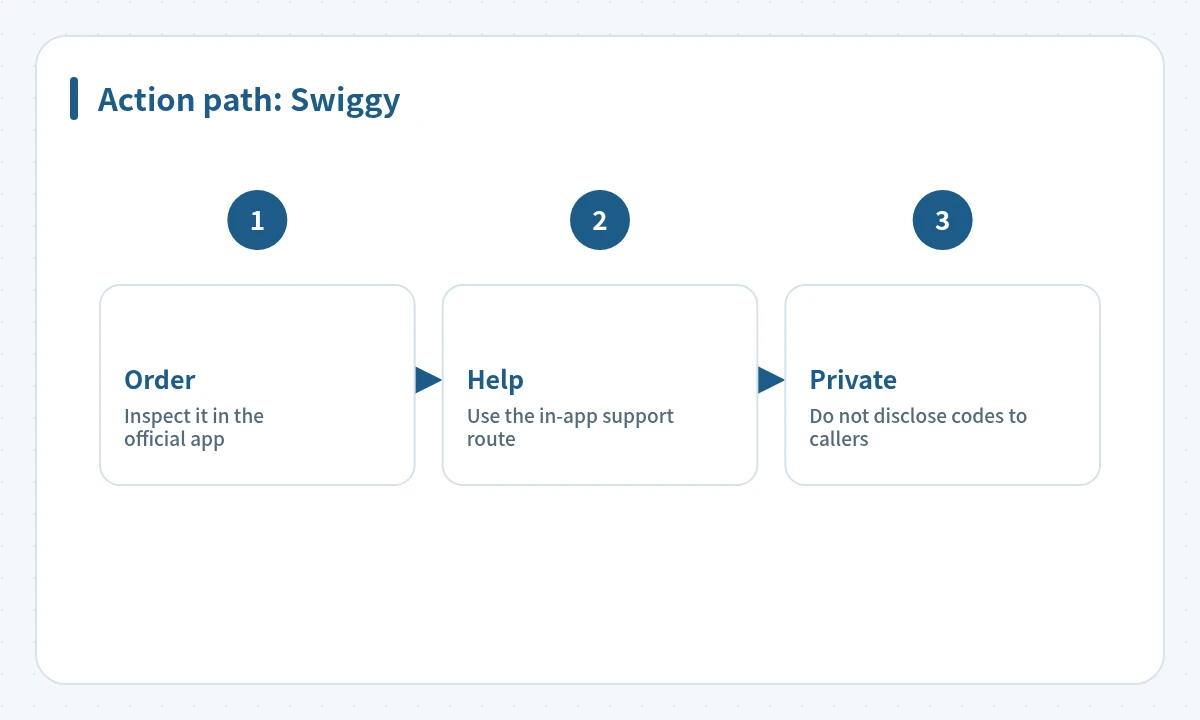
Preserve necessary screenshots and the order reference for the proper channel. Do not immediately assert that a particular account outcome happened, or let a stranger remotely control the device to inspect a refund. The legitimate support route should assess the current account and order state.
Judge progress through official order records and support responses rather than the caller's promised amount or timing. This guide concerns source checking and confidentiality, not a refund deadline. Order processing and account protection have distinct outcomes to inspect.
Where a later support reply requests clarification, keep it connected to the same order and sequence. That gives the team a clear history without spreading account details through additional unsolicited conversations or opening a fresh access request simply to satisfy the original caller.
References
Swiggy: Official customer care and in-app help; Swiggy: Fake helplines and refund approaches
