
An older SMS query can finish after a newer one and overwrite the current view. Simple SMS inbox access still needs a clear relationship between each response and the selection that produced it. The last response to arrive should not automatically become the result for the number now shown in the heading.
Give each query its own context
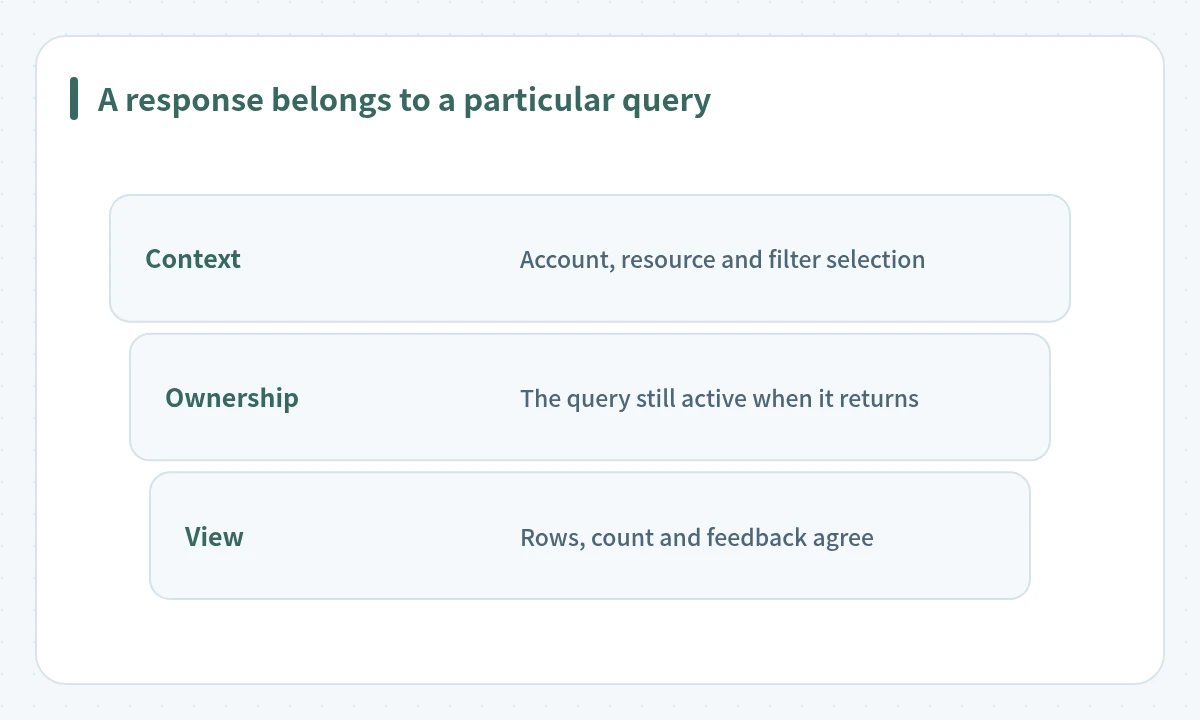
Keep the intended account, resource, filters and sorting with a request, alongside a local query identifier. Before applying its result, confirm that it still represents the active selection. This protects display consistency; server-side authorisation remains necessary independently.
When the resource changes, either clear old data or label it accurately while refreshing. Do not present one number’s messages under another number’s title. Error and loading states also belong to their own request, rather than whichever callback happens to update the screen last.
A count, selected row and export control can be affected even if the message list itself looks correct. Keep the whole result state associated with the same defined query so a user does not act on an unexplained mixture.
Cancellation and result ownership solve different parts
Where supported, AbortController can cancel related browser operations. It is useful when a query is superseded or its component is left behind. It does not establish that the remote server never processed the request.
Retain a current-query check even when cancellation is used. A response or callback may already be at another stage of application handling. The interface should know whether it may still apply, rather than assuming cancellation removed every possibility of an update.
Treat expected cancellation differently from a service failure. An obsolete search should not trigger an automatic recovery routine that reactivates its old filters. Follow the framework’s supported lifecycle handling rather than leaving callbacks attached to a view that no longer owns them.
Move pagination and selection together
A changed filter may require a new starting page under the product’s actual rules. Reset or preserve it deliberately. Keeping an old page index can produce an apparently empty result even when matching records exist elsewhere.
Use stable record references for actions and coordination. A row position can change when results are replaced. If a selected item no longer belongs to the current view, make its state explicit instead of silently applying an action to another row.
A debounced input can reduce requests while leaving the same ordering risk. Review whether the previous resource, search or page remains eligible to update the view after the delayed input starts a new query. Fewer requests are useful only if their ownership is still correct.
Test response order under controlled delay
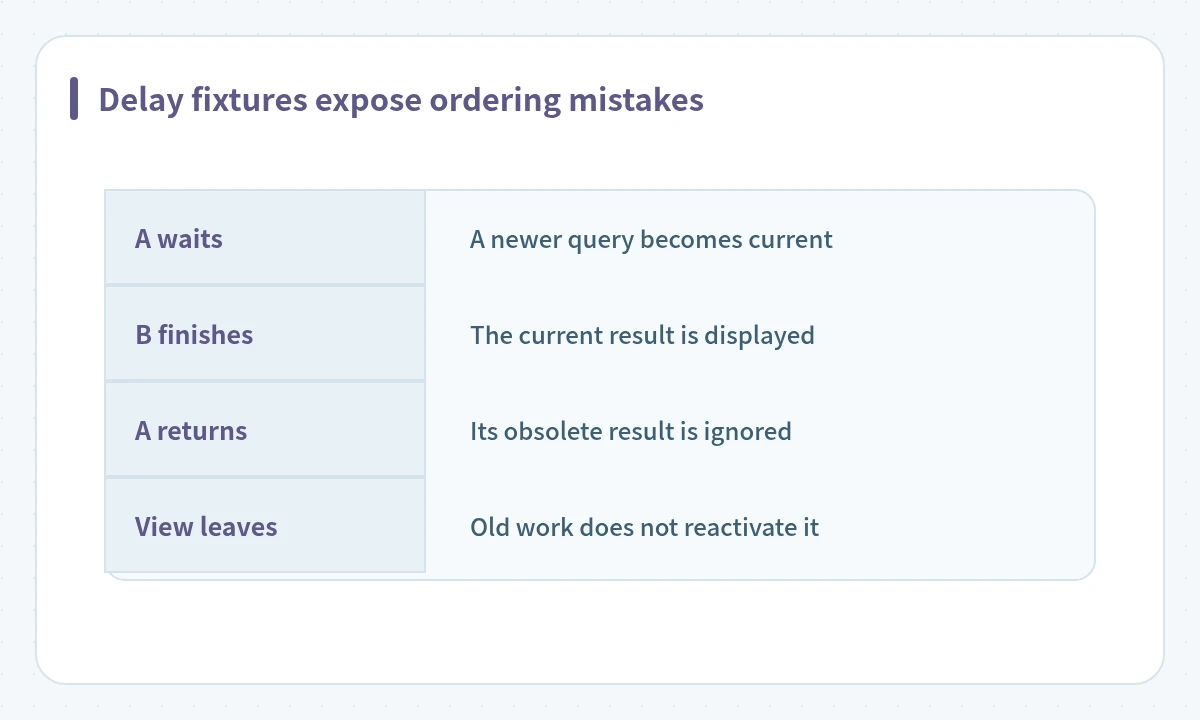
Prepare harmless queries A and B, delay A and let B complete first. Then release A. Inspect the list, count, loading indicator, errors and selected items. Repeat with an old failure, component navigation and an account change.
Use fictional records and a controlled test server or supported mock. Real verification messages are unnecessary for reproducing asynchronous order. The result should show which query owns the displayed state, without depending on a particular network speed.
A faster endpoint can make the fault rarer while leaving the ordering mistake intact. Close the issue when the current resource, conditions and completion state remain coherent across the tested transitions. That gives the reader a usable result rather than simply a page that usually updates in the expected order.
Reference: MDN: AbortController.
