
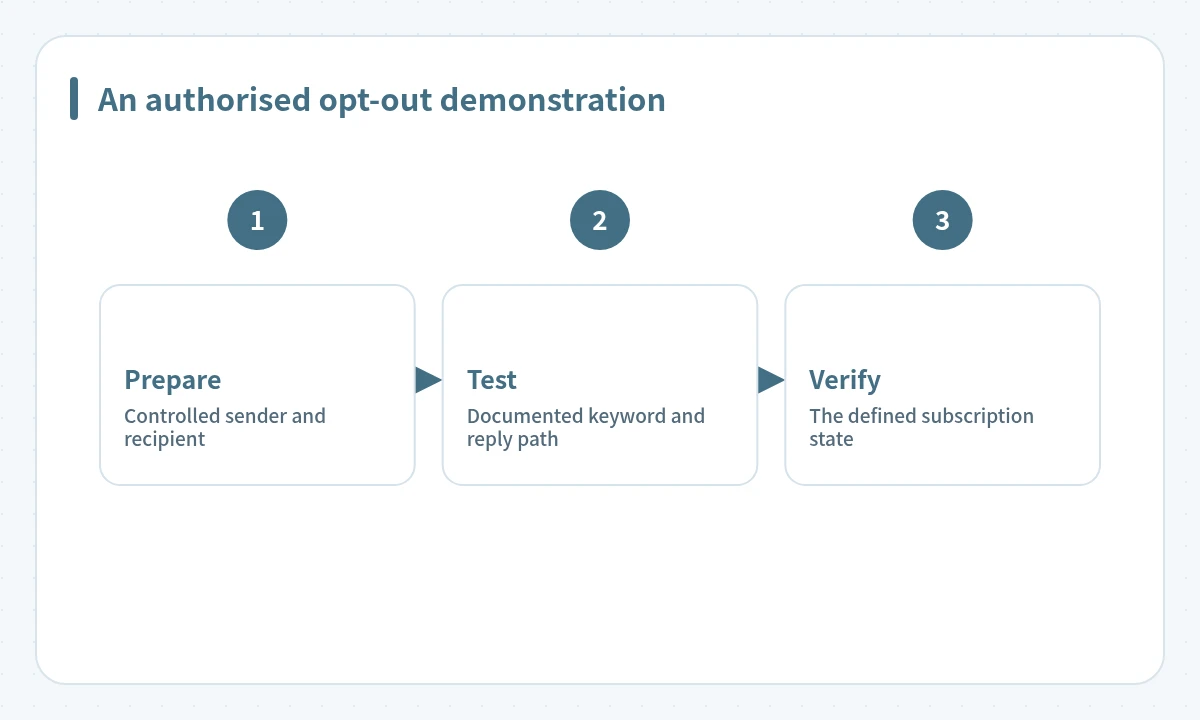
Test opt-out with a controlled sender, an authorised recipient and harmless content. A public inbox can expose messages to other viewers and may not support replies, so it is unsuitable for personal account recovery or subscription tests.
If you want to demonstrate an unsubscribe flow, use resources you are authorised to operate and harmless text that identifies the exercise. Establish the actual reply capability before planning a keyword test. A read-only inbox cannot demonstrate a two-way interaction simply because it displays a message containing the word STOP.
Define what the demonstration is meant to establish
A useful test asks whether a documented keyword changes the subscription state within a defined sending service. It does not try to prove that every sender on the internet will stop contacting the number. Write down the service, sender, recipient, language and expected confirmation before starting.
Avoid enabling or changing shared production settings just to obtain a screenshot. Configuration changes may affect other senders and users. Prefer an appropriately isolated test setup supported by the provider, with a clear owner and a way to return the resource to its intended state.
Twilio’s Advanced Opt-Out documentation is an example of a system with configurable keywords and language-specific responses. Its rules belong to that implementation. When using another provider, verify the supported keywords and their scope instead of copying a tutorial and assuming identical behaviour.
Observe the whole supported exchange
Record the initial authorised test message, the keyword sent through the intended reply path and the resulting confirmation or service state. If the provider documents a blocked subsequent send, check that outcome using its normal test procedure. Do not keep sending repeated real messages to a recipient who has withdrawn permission.
| Check | What it establishes |
|---|---|
| Reply path | The resource can send the required response |
| Keyword match | The configured language and text are recognised |
| State change | The intended subscription boundary changed |
| Follow-up handling | The application respects the documented outcome |
Do not translate a keyword by guesswork
The language of the surrounding message does not guarantee that every equivalent unsubscribe word is configured. Use the words the sending service documents for the relevant flow. If a demonstration needs another language, confirm its configuration and expected reply before testing it.
Likewise, a confirmation message is not a universal consent record. Your application may need to keep its own authorised preference state and should not send a second contradictory confirmation merely because it also received a callback. Follow the provider’s documented division of responsibility.
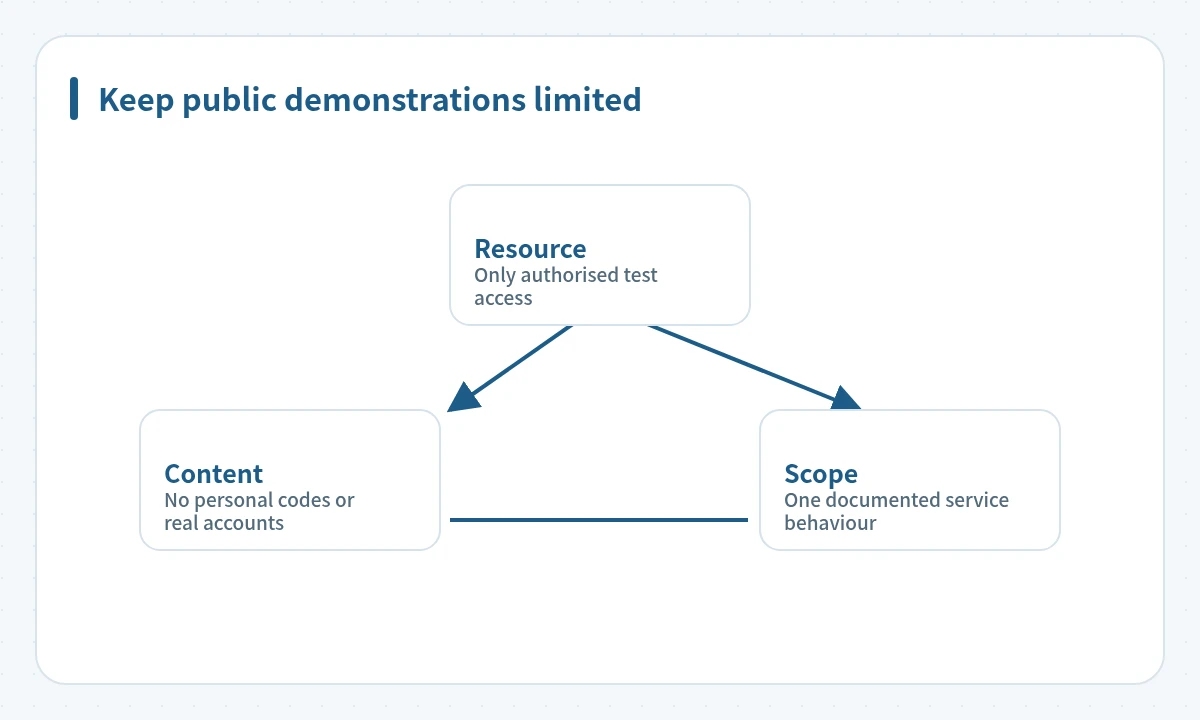
For a public presentation, replace real numbers, names and identifiers with clearly non-operational labels. Keep the content limited to the test result and the defined scope. Do not display someone else’s incoming texts to make the demonstration look realistic.
Afterwards, close the exercise deliberately. Document the final subscription state and which test resources remain active. If the number will be released or the demo page published, remove account dependencies and private material first. A clean demonstration shows how one supported flow behaves without turning a public inbox into a collection point for personal authentication messages.
Reference: Twilio: configuring Advanced Opt-Out.
