
Backslashes may belong to JSON syntax or to a string that was encoded twice. Identify whether you are viewing raw JSON, a parsed string or an encoded object before removing characters.
Inspect the value type before decoding again
JSON text represents characters such as quotes and line breaks through escapes. A debugger can also show a string using an escaped representation. The appearance of a screenshot therefore does not establish how many encoding layers exist in the data path.
A separate integration mistake occurs when an application serializes a record into text and then serializes that text inside another response. After parsing the outer response, the caller can receive a string where the contract expects an object. Whether another parse is legitimate must come from the field definition, not from repeatedly trying until something looks readable.
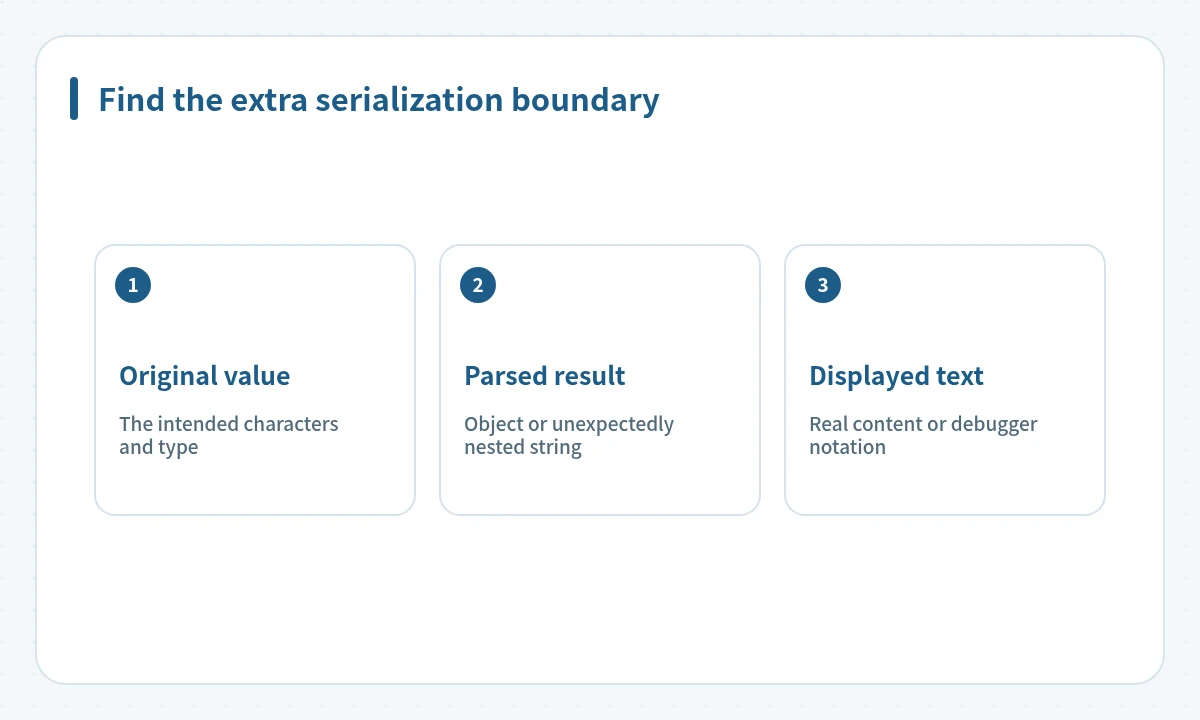
Compare four points using a harmless fixture
| Point | What to inspect |
|---|---|
| Business object | Original characters and field types |
| Serialized output | Object structure or a string containing that structure |
| Parsed value | The actual type and value returned to the caller |
| Display | Message contents or a debugging representation |
Include ordinary text, a real line break and a backslash that should remain in the message. Do not use a real code. Those fixtures distinguish correct representation from a replacement rule that changes legitimate content. Preserve the source sample and work on a copy rather than repeatedly editing the only evidence.
A field containing the literal characters for a backslash followed by a letter is not necessarily equivalent to a control character. Compare the exact decoded value under the contract. A formatting tool making both versions look similar is not enough to establish equivalence.
For a suspected serialization defect, retain the endpoint and version involved. An export tool and a live API may intentionally expose different wrappers. Comparing their screenshots without their schemas can manufacture a problem that belongs to the comparison method, so establish the expected type for each source independently.
Fix the boundary that violated the contract
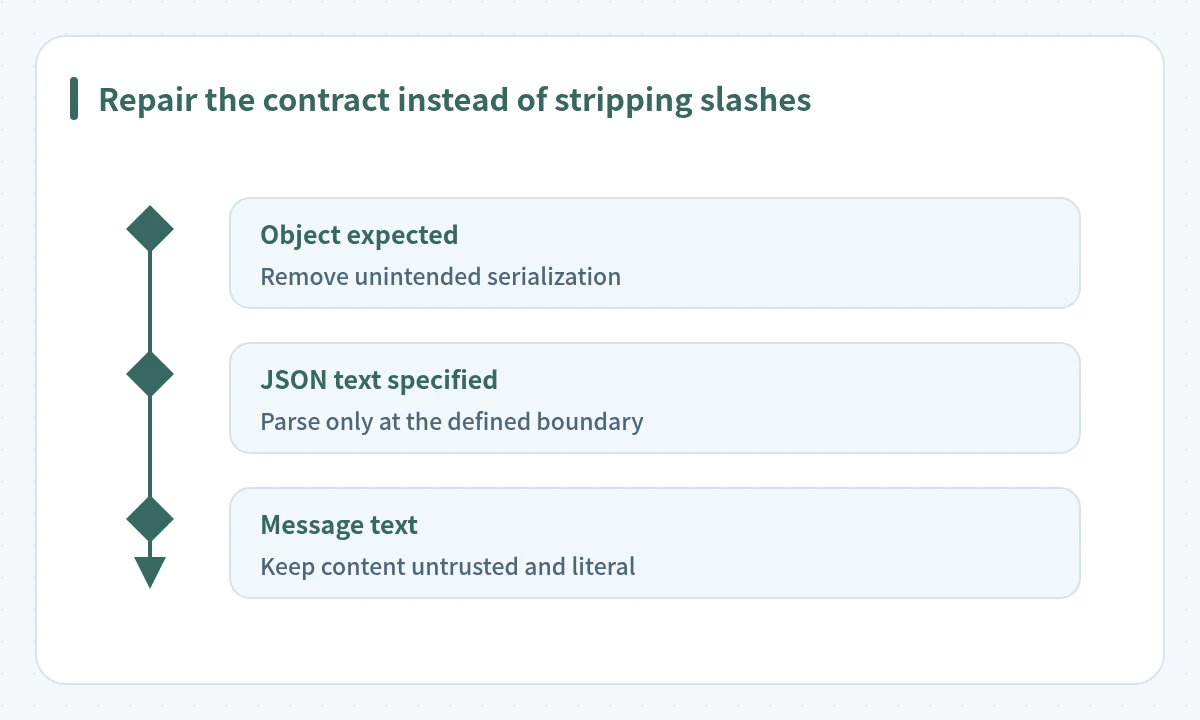
If the response is supposed to contain an object, remove the unnecessary serialization at its source. If a documented field intentionally contains JSON text, parse it at that specified boundary and validate the result. Do not introduce a general recursive decoder for all incoming SMS contents: an ordinary message can legitimately contain code-like text.
Parsing JSON also does not make the body trusted HTML. Render messages through an appropriate text-safe output path rather than inserting markup for execution. Decoding and safe display are different responsibilities, even when the same screen exposes the problem.
Acceptance should compare the final characters with the retained fixture and cover empty strings, missing fields and invalid input. Check the resulting value type as part of the API test. This gives the next maintainer a concrete failure to locate rather than a rule about deleting visible slashes whenever a user reports unreadable text.
Keep private files out of unfamiliar online formatters. A small synthetic example normally carries enough structure to explain a double-encoding defect without exposing an inbox export or operational authentication material.
References: MDN: JSON.parse; MDN: JSON.stringify.
