
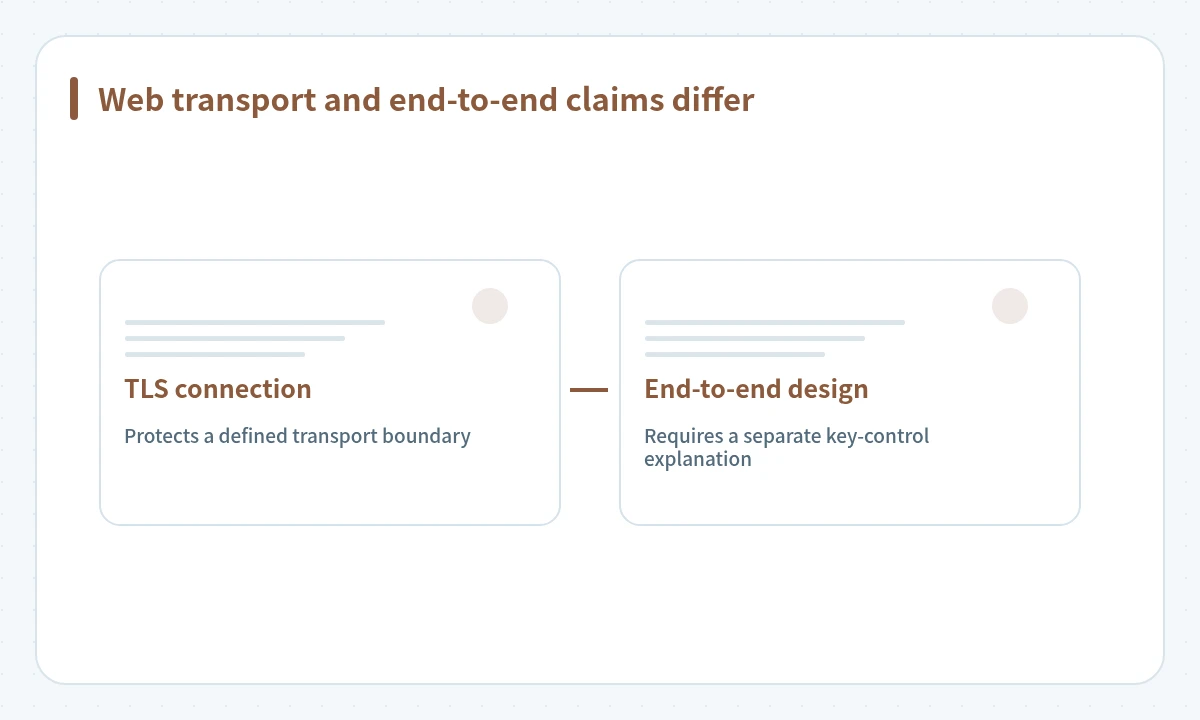
HTTPS on a receiving page protects a particular transport connection; it does not prove that the whole SMS path is end-to-end encrypted. A private phone number to receive SMS verification codes still needs a clear explanation of who handles readable content, how access works and what happens to copies. The browser connection answers only part of that assessment.
Follow the content through each boundary
The sending business, communication path, receiving provider and web interface can represent different stages. TLS on the web connection protects traffic between the browser and the corresponding service. It does not, by itself, describe every earlier stage or prevent that service from processing readable content.
An end-to-end encryption claim requires a separate explanation of the endpoints and key control. Ask who can decrypt, where keys are used and what recovery or synchronisation implies. Words such as “secure” and “encrypted” without that scope do not establish that intermediaries cannot read messages.
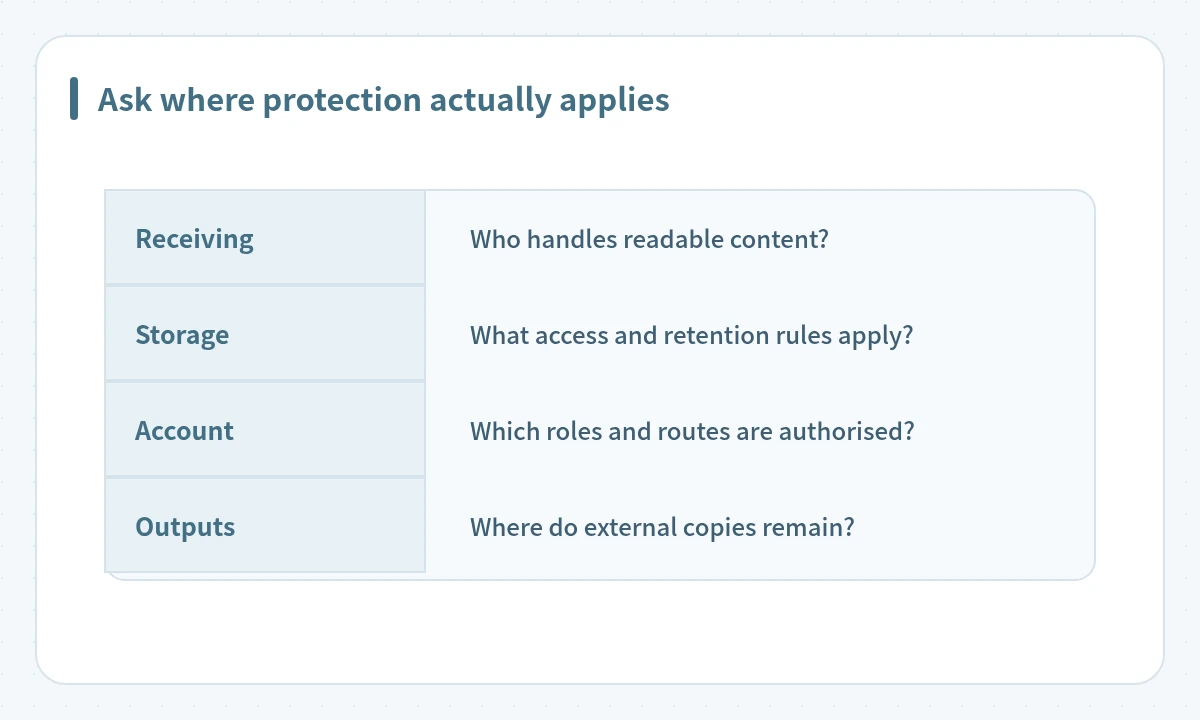
| Boundary | Question to ask |
|---|---|
| Web transport | Is the connection valid and the domain expected? |
| Service storage | Who can obtain readable content under which conditions? |
| Account access | How are members, integrations and recovery authorised? |
| External copies | Where do downloads and notifications go? |
Exclusive allocation is a different property
A number allocated to one customer can still be managed through an account with several members or integrations. Exclusive use does not define administrator access, export permissions or the security of an already signed-in shared computer. Assess the resource relationship and the account controls separately.
A public inbox is also not made suitable for personal recovery merely because its page uses HTTPS. The connection can be protected while the intended audience of the content remains broad. The problem in that situation is not solved by a transport indicator.
Keep using transport protection correctly
These limits are not a reason to ignore an invalid certificate or an unexpected domain. Stop entering credentials when the connection or destination is uncertain, and confirm the official entry point. Each protection serves its own purpose; a gap elsewhere does not make the web connection unimportant.
Similarly, do not upload private texts to an unfamiliar tool that promises to check whether they are encrypted. That would create another disclosure route without establishing the architecture of the original service. Use product documentation and appropriately scoped questions instead.
Ask whether an answer applies to the live receiving service, a particular integration or a separate messaging product. Security properties from one product should not be transferred to another because they share a brand name.
Ask for a data flow rather than a slogan
For a business assessment, request an explanation that includes receiving, storage, authorised staff access, logs, backups and outputs. Mark any unaddressed area as unconfirmed. Do not fill missing information with the assumption that no person or service can ever read the contents.
Choose tasks according to their sensitivity and the controls that are actually established. Active authentication material should not be forwarded to someone claiming to provide support. Handing it to another person changes its audience regardless of how the web connection was protected.
MDN’s TLS documentation describes transport security. Reading that boundary accurately helps preserve its value while leaving account, storage and message-path questions visible. A useful evaluation records which protection applies where, rather than awarding one broad security label to the entire arrangement.
Reference: MDN: Transport Layer Security.
