
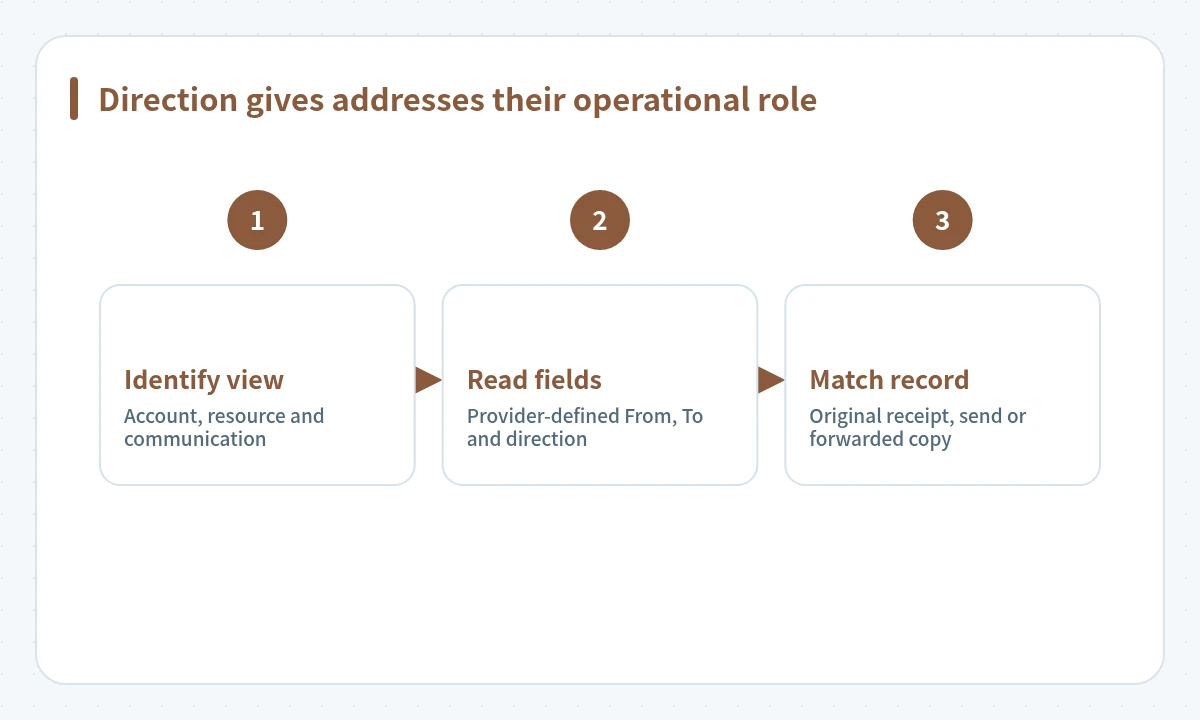
Read From and To according to the message direction documented by the provider. Your number appearing in a log is not enough to distinguish an inbound message from an outbound test or a forwarded copy.
Establish the communication the row represents
For an ordinary inbound message, the receiving resource is the destination. For an outbound message from that resource, it can be the sender. Read the endpoint’s field definitions and any direction or channel value alongside the addresses. Do not assume every dashboard uses the same perspective or naming convention.
Twilio’s Message resource documents addresses, message identity and direction separately. That structure helps distinguish a received record from a send request. The source IP of a webhook is another object entirely; it is not the SMS sender address merely because both are called a source somewhere in the system.
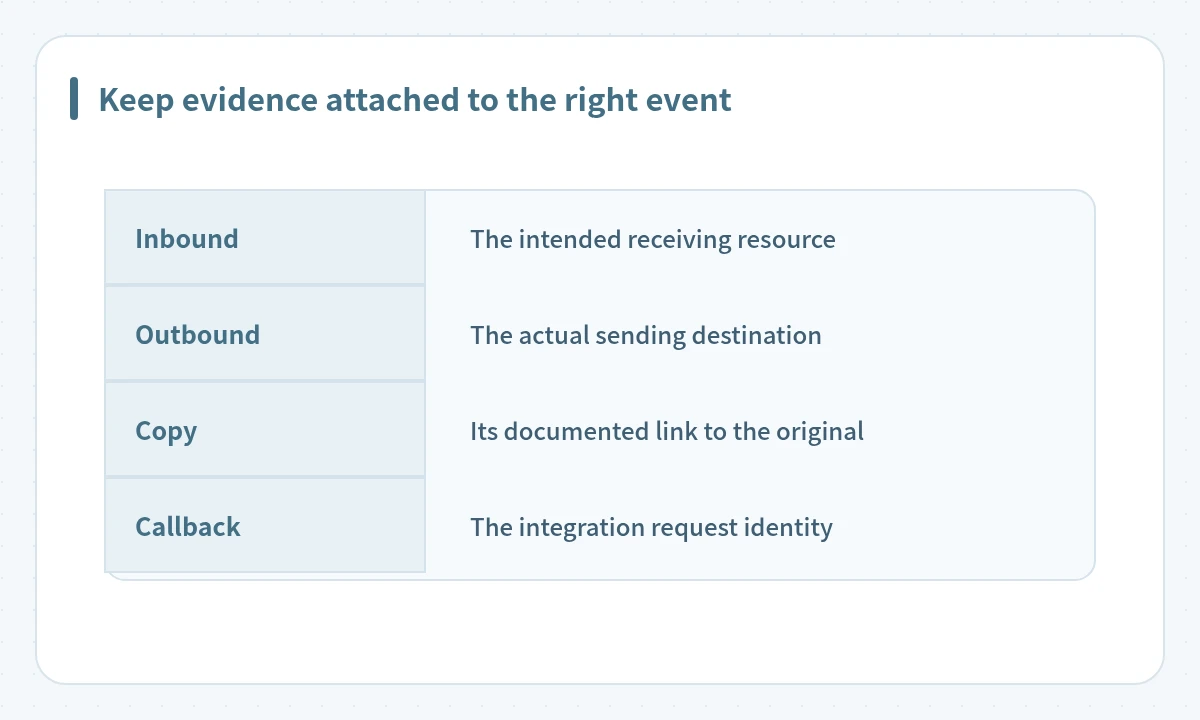
| Record | Association to establish |
|---|---|
| Original inbound message | Receiving resource, inbound direction and message identifier |
| Outbound test message | Sending resource, actual destination and send result |
| Forwarded copy | A separate destination and supported link to the original |
| HTTP callback | The event and request identity defined by that integration |
Forwarding creates another communication
As a fictional illustration, a message can enter resource A and then be forwarded to resource B under an authorised rule. The system may record the original receipt and the subsequent send separately. The To field of the copy should not silently replace the original message’s receiving address.
This illustration does not claim a particular inbox supports forwarding. Where the service supplies a documented correlation reference, use it. Where it does not, identical body text alone is insufficient to establish that two rows are the same logical event.
If both endpoints are resources you administer, keep the queried resource explicit. The observation obtained from one account or endpoint should not be silently treated as the observation from the other. Check how that provider represents the two sides instead of assuming that every related communication appears as exactly one shared row.
Filter the evidence to the question
When investigating an absent incoming message, select the intended account, resource and time range, then apply supported direction filters. A successful outbound acceptance is not substitute evidence of inbound receipt. Likewise, an outbound record produced by an automated reply should not be counted as another incoming customer message.
If time fields have different meanings, preserve those definitions. A request creation time and a receiving time may not represent the same stage. Combining them under one unlabeled timestamp can make an address-direction error appear to be a delivery delay.
For an isolated interface test, use non-operational labels for sender and recipient and make the expected direction explicit. Check table headings, detail views and export fields against the same fixture. No live authentication text is needed to discover that two display columns were swapped.
An incident report should identify the resource, direction, message reference and query scope before adding body content. That lets support establish whether everyone is discussing the same communication. Once that is clear, the next investigation can address sending, receipt or copy processing rather than repeatedly refreshing a list built from the wrong direction.
Reference: Twilio: Message resource addresses and direction.
