
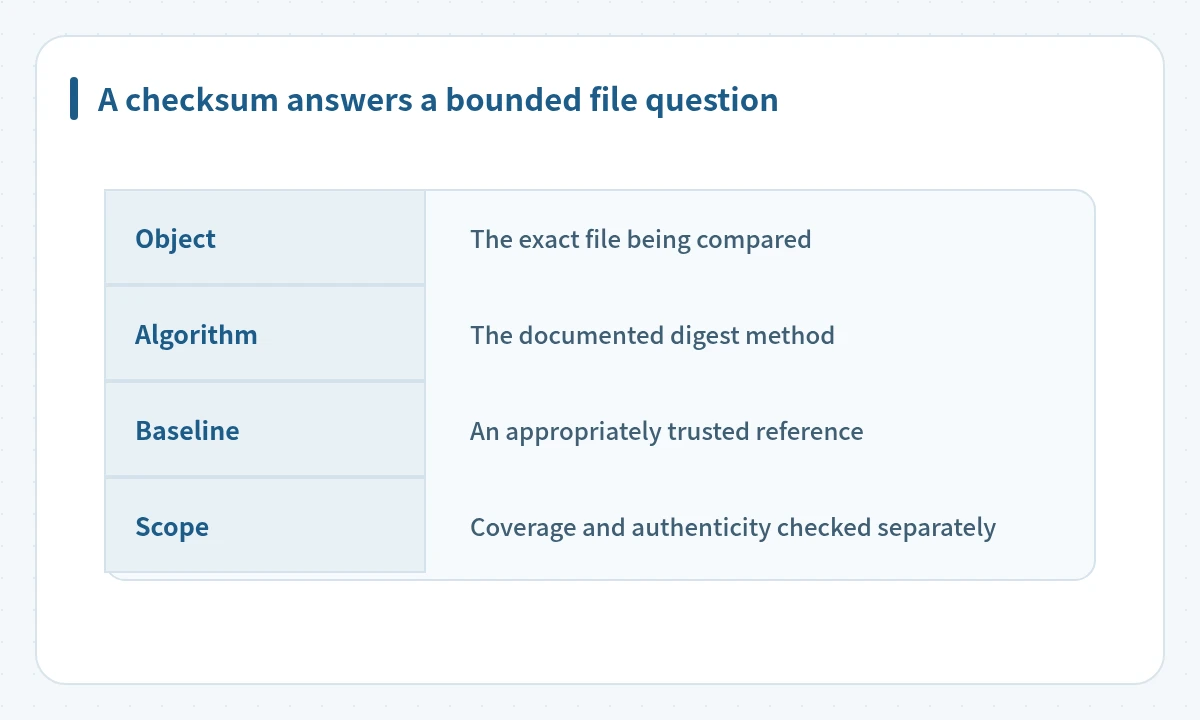
A checksum can detect a file change against a trusted reference. It does not by itself establish message authenticity, completeness or sender identity; keep integrity, provenance and query coverage separate.
Establish where the reference came from
A hash function maps input data to a digest. With an appropriate algorithm and a trusted baseline, comparing the same file’s bytes helps identify changes during transfer, storage or editing. NIST’s terminology explains the mechanism; the digest does not independently authenticate whoever first produced the file.
If an untrusted sender supplies both an attachment and a matching checksum, agreement does not make the source trustworthy. Obtain the baseline through the verified export workflow or another suitable trusted channel. A string printed beside a download button is not automatically proof of provenance.
| Question | Evidence needed |
|---|---|
| Did the file change? | The correct file, algorithm and trusted reference |
| Which account and query produced it? | The authorised source and retained export scope |
| Does it contain the needed records? | Coverage, field definitions and readable content |
| Does it establish a business fact? | The relevant reliable business evidence, beyond a digest |
Preserve an original before making a working copy
Where retention is authorised, keep the original separately before filtering, annotating or converting the data. A line-ending or encoding change can alter the bytes even if much of the visible text appears the same. A mismatch is a reason to investigate the transformation, not immediate proof of malicious tampering.
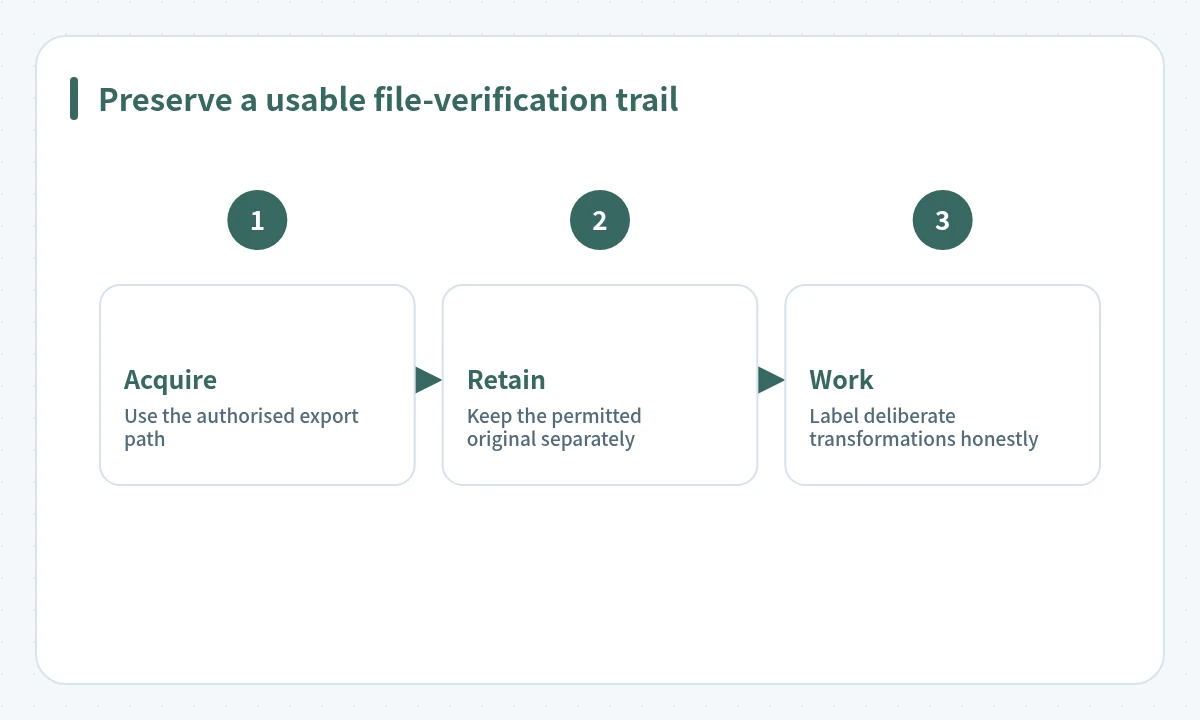
Use a trusted local tool where appropriate rather than uploading a private export to a random checksum website. Confirm that the file being checked is the actual original, not a similarly named later download. Record the algorithm as well as the reference value so the comparison can be reproduced meaningfully.
A working copy should have a clear purpose and an honest label. Do not edit an export until its content meets an expectation and then present the changed file as an untouched source record. The distinction matters even when the edits are harmless formatting changes.
Compare the same object at both ends. A checksum for a compressed download describes that archive, not automatically each file extracted from it. If the provider supplies a manifest, read which files and algorithms its entries cover before comparing an inner CSV with a digest intended for the outer package.
A matching checksum leaves other checks open
A file can survive transfer unchanged while containing only one page or a narrow date filter. Inspect the expected resource, period, fields and readability. Retain enough non-secret query context to explain those limits later. Integrity cannot answer a coverage question that was never established at export time.
If repeated downloads differ, ask whether the provider regenerates ordering, metadata or timestamps. Compare through the normal authorised route before deciding the original was damaged. Do not infer missing message text from a checksum or treat it as a recovery mechanism.
Keep only the records required for the legitimate task. File verification is not a reason to archive active codes or unrelated personal messages. A useful retention note describes the source, acquisition time, scope, file and comparison method without inflating a technical digest into a guarantee of identity or business truth.
Reference: NIST: hash function terminology.
