
Before a daylight-saving change, confirm the intended time zone and specific scheduled occurrence. A changed local clock can alter an expected send time without proving a receiving delay.
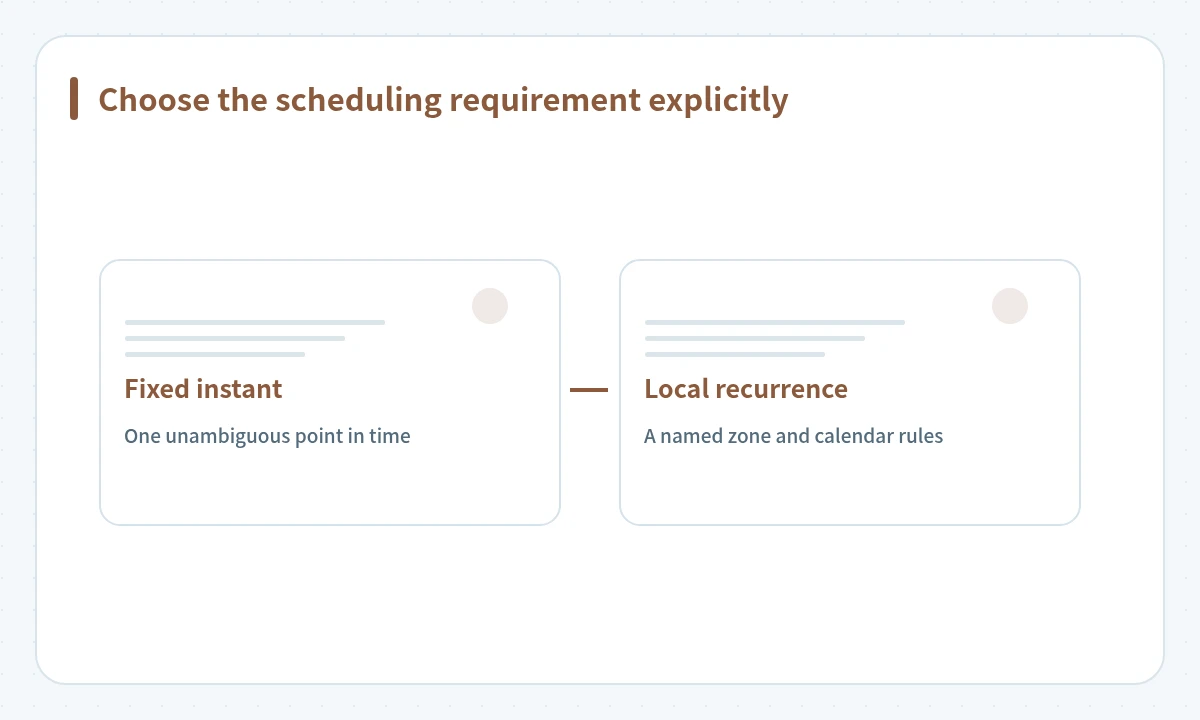
Decide whether the requirement follows local time
A one-off UTC timestamp identifies a particular instant. A recurring local-time instruction needs a named time zone and its applicable rules. Across the year, the same local hour can correspond to different UTC times. Both requirements can be valid, but the business must choose deliberately.
A receiving number’s prefix is not a substitute for the recipient’s stated time preference. Keep the intended zone and date in the requirement, rather than retaining only an approximate conversion made by someone in another office.
If an API accepts a timestamp, follow its actual format and scheduling constraints. Twilio’s Message Scheduling documentation is one implementation example. It does not establish that every provider understands a recurring local-time expression or manages repeated jobs automatically.
Review the exceptional times on transition days
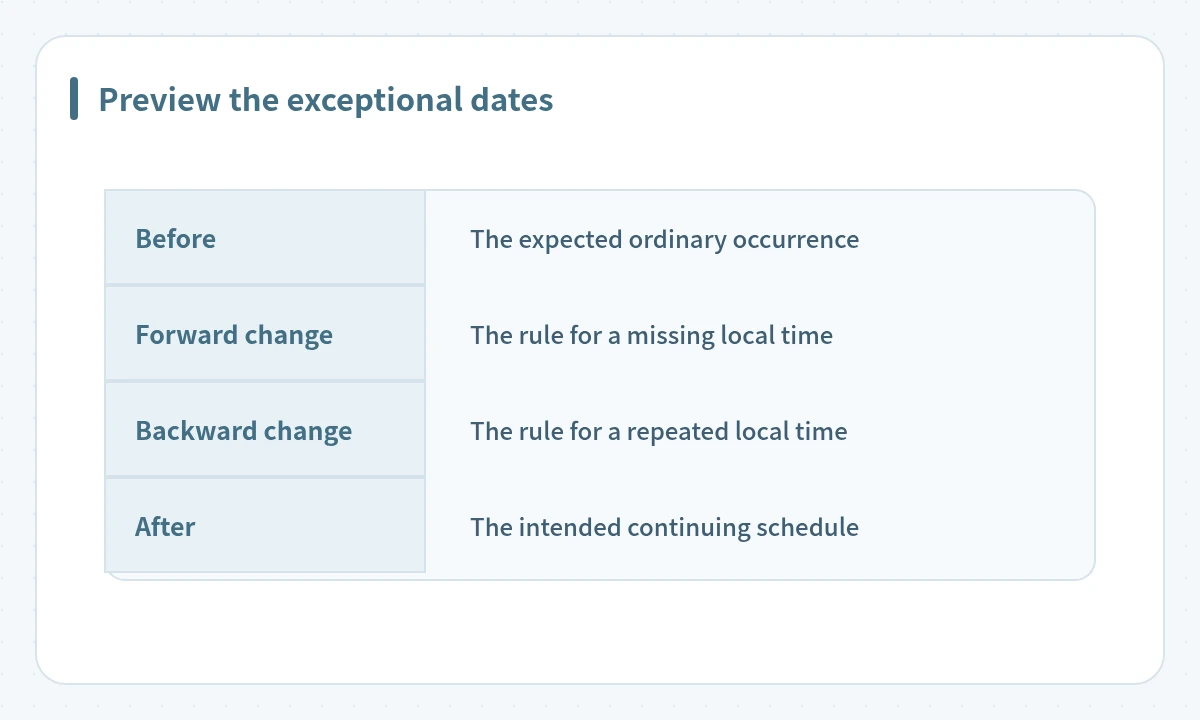
When a local clock moves forward, some displayed times may not occur. When it moves backwards, part of the clock hour may occur twice. A scheduler needs a defined way to handle those cases. Skipping, shifting and running twice should not be treated as interchangeable defaults.
| Requirement | Configuration to clarify |
|---|---|
| One-time reminder | A full date and unambiguous target instant |
| Recurring local-time task | A named zone and transition-day behaviour |
| Fixed elapsed interval | An interval origin and its relationship to clock changes |
Ask the scheduler’s own documentation or maintainer how missing and repeated times are handled. An interface showing a familiar clock value is not proof that this decision has been made. Record the chosen rule with the business requirement so a later operator can understand it.
Inspect future occurrences without sending real messages
Where a supported preview exists, review planned occurrences before, during and after the transition. Otherwise use an isolated calculation or scheduler test that does not send to real users. Repeated customer notifications are not necessary to inspect time arithmetic.
Include cases that use the intended named zone rather than just the server’s default. A test that accidentally uses the developer’s local setting can appear correct while missing the deployed task’s rule. Keep the original requirement beside the expected calculated times.
Keep a named zone distinct from a fixed numeric offset in stored requirements. The offset describes a relationship at a particular instant; a named zone lets the scheduling system apply its supported calendar rules. Record which representation the actual interface accepts.
Separate the planned instant from later observations
In operation, retain the planned time, actual submission time and receiving observation as distinct fields. If the plan itself was one hour off, investigate the requirement or scheduling configuration. If submission matched the plan, investigate later stages using their own records.
Time-zone rules can change. IANA maintains the time-zone database, while actual applications and operating systems need an appropriate update path. An old long-range plan should be rechecked before use rather than treated as permanently correct.
The completion criterion is that the schedule follows the chosen business rule on the relevant dates. Receiving a test message once cannot establish that an entire recurring calendar is correct.
References: IANA time-zone database; Twilio message scheduling.
