
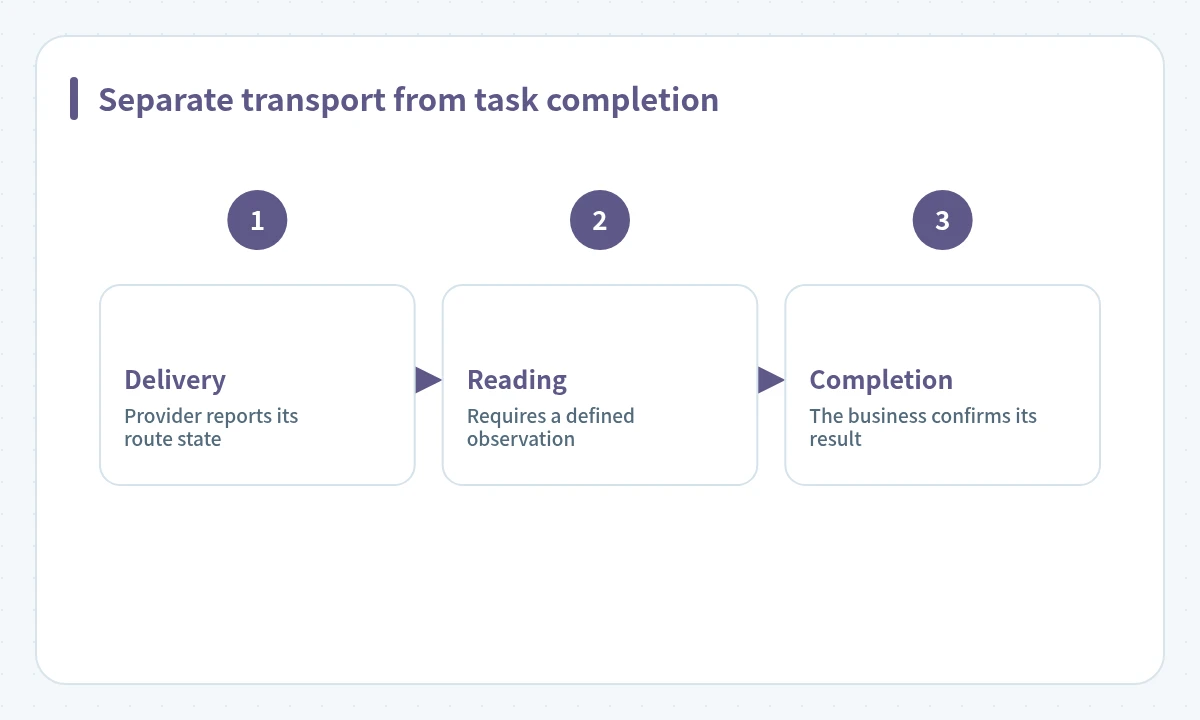
A delivery status describes a messaging route. Reading the text, entering its code and completing the business task require separate evidence from the relevant application.
The practical question is: which event produced the status you are looking at? A sending API, a carrier update, an online inbox and an order system can each report a different stage. Labels that sound reassuring are only useful when their source and meaning are clear.
Start with the channel and direction
Twilio’s outbound status guide distinguishes sending and delivery states, and describes read events for supported messaging channels. Its Message resource specifies that the read status applies to WhatsApp, rather than ordinary SMS. A report that combines channels must not silently apply one channel’s capabilities to another.
This does not mean an SMS inbox cannot have a local read marker. It means that such a marker may be a feature of the inbox application, with its own rules. Opening a row, displaying a preview and explicitly marking a task complete are different actions; check which one the service records.
| Observation | What still needs another check |
|---|---|
| The sending service reports delivery | Whether the intended person saw the content |
| A message appears in the receiving inbox | Whether it belongs to the intended account task |
| An inbox row is marked read | Whether anyone completed or declined the work |
| The target website confirms verification | Whether the wider business transaction also finished |
Define completion before building the report
For a verification journey, the meaningful endpoint may be the target site accepting the current request. For a delivery notice, it may be a customer acknowledging a change through the official order page. For a team inbox, it may be a named assignee recording a resolution. Pick the event that answers the actual operational question.
Do not infer that endpoint from the transport status because no stronger signal is available. If the system cannot observe human reading, report that limitation plainly. A dashboard can accurately show delivery without inventing an engagement rate or calling every delivered message a successful transaction.
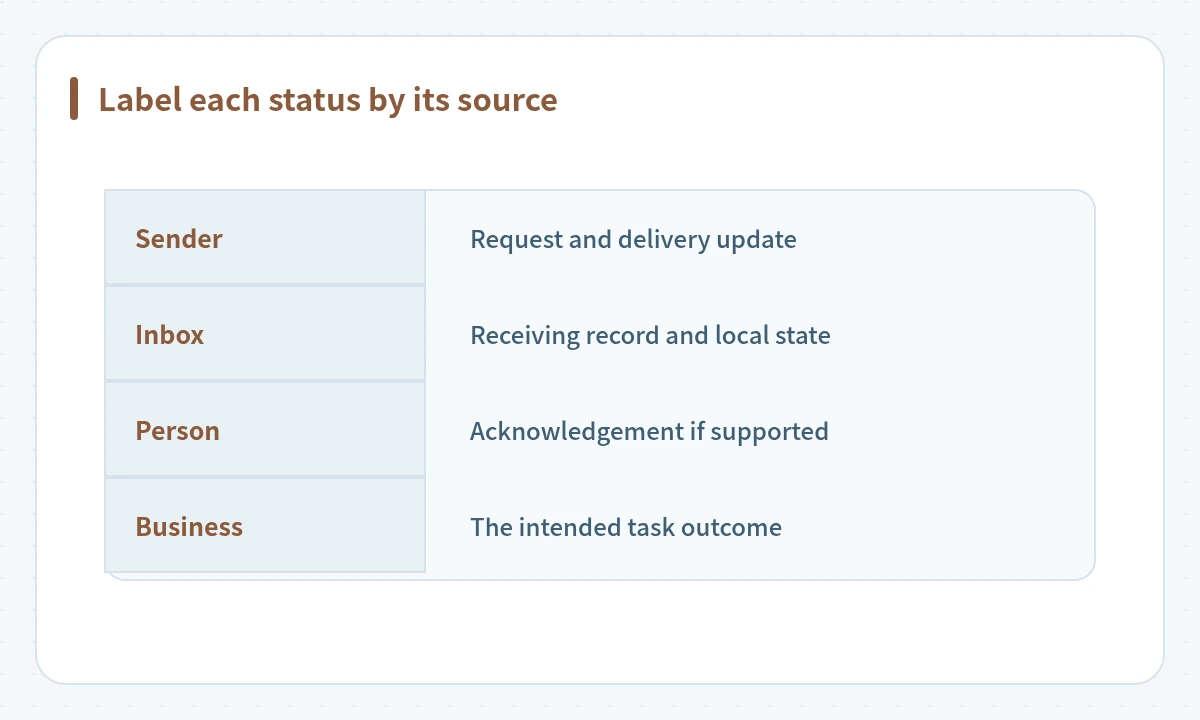
Keep asynchronous updates from changing the story
Status updates may arrive after the original send response. Store the message identifier, event source and relevant timestamp together. If a system receives repeated or late updates, its documented state handling should decide what to retain; arrival order alone is not a reliable account of the business sequence.
A support enquiry should say which status came from which service. For example, describe an outbound message marked delivered while a particular authorised inbox query has no matching record. Include the time range and non-secret reference, rather than saying “the user definitely received it.” That wording leaves room to investigate routing, recipient selection and the receiving application.
For user-facing progress, use labels that match the evidence: submitted, accepted, delivery reported, or task confirmed. Only show a stronger claim when the corresponding system supplies it. Clear status language prevents someone from closing an unresolved task merely because the transport layer has finished its part.
References: Twilio: outbound message status; Twilio: Message resource.
