
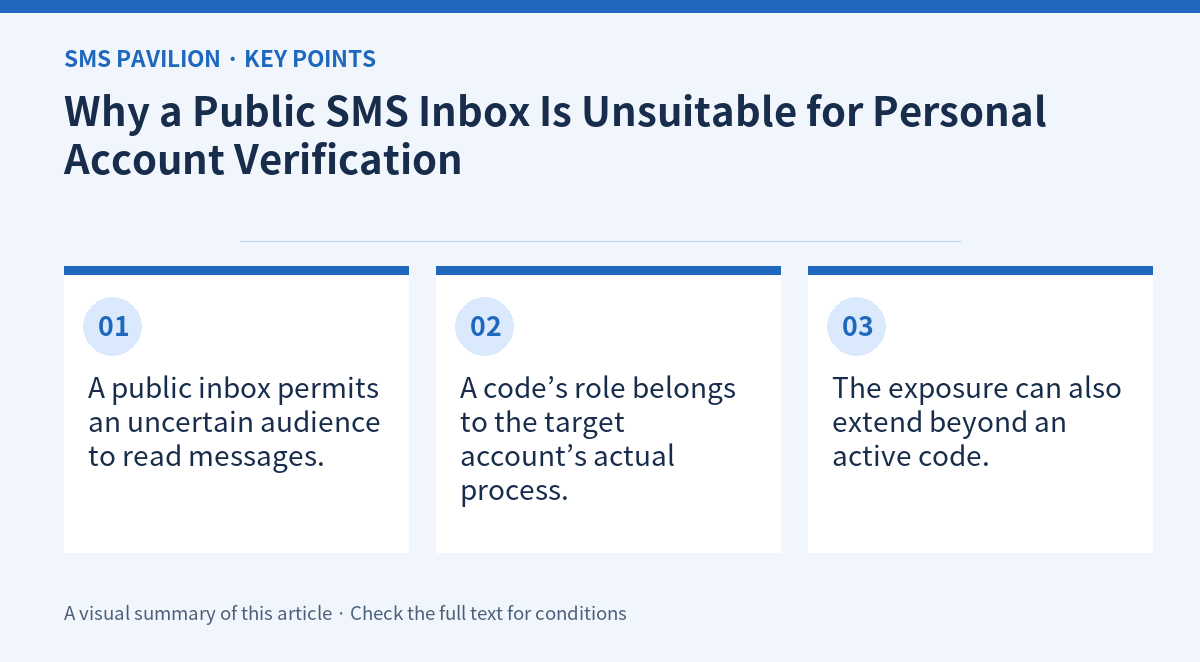
A public inbox permits an uncertain audience to read messages. Availability of a number does not establish a private verification route for a personal account.
For the complete workflow around this question, continue with Number Rental Guide: Selection, Renewal, Handover and Exit. The link opens the relevant section.
Verification depends on who can see the secret
A code’s role belongs to the target account’s actual process. If unrelated visitors can read that code, its arrival alone cannot establish exclusive access for you. Masking part of the displayed telephone number does not solve the problem if the message itself remains publicly readable.
The exposure can also extend beyond an active code. Notifications may identify a service, an account state or part of an order. An expired code does not automatically make the surrounding information harmless. Consider what the message reveals and who the page permits to read it before linking a personal account to that resource.
Removing a page is not recalling every copy
If the service permits deletion, that action still does not establish that nobody previously read, copied or captured the message. Do not assume control over another visitor’s local copy. Cache, retention and backup policies also require their own explanation from the actual provider.
Number control has a separate lifetime. A public resource that works now does not establish that you will control its reading audience when an account later requests recovery or another verification. A successful initial sign-up and continuing account control are different outcomes.
Before choosing a receiving method, resolve the visibility, management, duration and target-service acceptance questions. If the answers do not fit personal verification, use an approved alternative instead of repeatedly trying different public resources. Public availability should not be treated as permission to access an existing account associated with the number.
If you already used the number, review your own account
Enter through an independently known official application or website. Check the supported contact-change and recovery options while you still have authorised access. Confirm that the replacement route works through the service’s normal procedure before removing the old dependency. Do not share active codes with strangers offering to perform that change for you.
Google’s account-recovery guidance is an example of a provider-defined process for confirming ownership of your own account. It is not a universal recovery rule or a promise that every account can be recovered using a currently readable number. An organisation’s account may need its administrator instead.
Keep the cleanup scoped to accounts you own and resources you are permitted to manage. If a public inbox contains another person’s message, do not use it to investigate or take over their account. For your own transition, a small record of the affected account and completed contact-change step is generally more useful than archiving old verification secrets.
The result to aim for is a supported private access arrangement with understood recovery conditions. Receiving one message on an open page does not supply those conditions by itself.
Reference: Google Account Help: recovering your own account.
